
Monofocal Lenses
Clear sight at a distance
More than 55,000 lens implants performed
Premium lens technology from ZEISS, Alcon & Co.
Quality, comfort, and progress
flexible financing - no prepayment




Monofocal Lenses
Clear sight at a distance
More than 55,000 lens implants performed
Premium lens technology from ZEISS, Alcon & Co.
Quality, comfort, and progress
flexible financing - no prepayment
Monofocal Lenses
Clear sight at a distance
More than 55,000 lens implants performed
Premium lens technology from ZEISS, Alcon & Co.
Quality, comfort, and progress
flexible financing - no prepayment
Monofocal Lenses
Monofocal lenses are a proven and commonly used form of intraocular lens. They are implanted through a very small incision at the edge of the cornea during a minimally invasive procedure. The natural, cloudy lens is replaced without changing the basic anatomy of the eye. The procedure is considered safe, routine, and has been successfully performed for many years.
A monofocal lens is always set for a fixed viewing distance. In general, it is chosen so that seeing at a distance is sharp and clear. This means that activities such as driving, watching television, or recognizing people and street signs work well without glasses. For near vision, such as reading or fine work, reading glasses are typically still needed.
Alternatively, the lens can also be specifically adjusted for near vision. In this case, reading without glasses is possible, while a visual aid is required for distance vision. Which setting makes sense depends on your personal vision habits, your daily life, and your priorities, and will be discussed in detail during the preliminary examination.
Monofocal Lenses
Monofocal lenses are a proven and commonly used form of intraocular lens. They are implanted through a very small incision at the edge of the cornea during a minimally invasive procedure. The natural, cloudy lens is replaced without changing the basic anatomy of the eye. The procedure is considered safe, routine, and has been successfully performed for many years.
A monofocal lens is always set for a fixed viewing distance. In general, it is chosen so that seeing at a distance is sharp and clear. This means that activities such as driving, watching television, or recognizing people and street signs work well without glasses. For near vision, such as reading or fine work, reading glasses are typically still needed.
Alternatively, the lens can also be specifically adjusted for near vision. In this case, reading without glasses is possible, while a visual aid is required for distance vision. Which setting makes sense depends on your personal vision habits, your daily life, and your priorities, and will be discussed in detail during the preliminary examination.
Monofocal Lenses
Monofocal lenses are a proven and commonly used form of intraocular lens. They are implanted through a very small incision at the edge of the cornea during a minimally invasive procedure. The natural, cloudy lens is replaced without changing the basic anatomy of the eye. The procedure is considered safe, routine, and has been successfully performed for many years.
A monofocal lens is always set for a fixed viewing distance. In general, it is chosen so that seeing at a distance is sharp and clear. This means that activities such as driving, watching television, or recognizing people and street signs work well without glasses. For near vision, such as reading or fine work, reading glasses are typically still needed.
Alternatively, the lens can also be specifically adjusted for near vision. In this case, reading without glasses is possible, while a visual aid is required for distance vision. Which setting makes sense depends on your personal vision habits, your daily life, and your priorities, and will be discussed in detail during the preliminary examination.
Which patients choose this lens?
Patients who have problems with distant vision only
Patients over 40/45 years old who are struggling with altered vision and have not yet taken the overall step to trifocal lenses
Patients with a smaller budget
Patients with cataracts
Disadvantages:
subjectively poorer vision and contrast sensitivity at night
no correction of astigmatism and presbyopia
usually reading glasses are necessary, as the eye cannot adjust to both vision conditions (far / near)
Which patients choose this lens?
Patients who have problems with distant vision only
Patients over 40/45 years old who are struggling with altered vision and have not yet taken the overall step to trifocal lenses
Patients with a smaller budget
Patients with cataracts
Disadvantages:
subjectively poorer vision and contrast sensitivity at night
no correction of astigmatism and presbyopia
usually reading glasses are necessary, as the eye cannot adjust to both vision conditions (far / near)
Which patients choose this lens?
Patients who have problems with distant vision only
Patients over 40/45 years old who are struggling with altered vision and have not yet taken the overall step to trifocal lenses
Patients with a smaller budget
Patients with cataracts
Disadvantages:
subjectively poorer vision and contrast sensitivity at night
no correction of astigmatism and presbyopia
usually reading glasses are necessary, as the eye cannot adjust to both vision conditions (far / near)
Premium Lens Technology From ZEISS, Alcon & Co.
When implanting monofocal lenses, the quality of the lens used is a crucial factor for a clear and stable visual outcome. In the partner clinic, only proven brand lenses from renowned manufacturers such as Zeiss, Alcon, and comparable international medical technology companies are used. These lenses are based on many years of research, extensive clinical experience, and high quality standards.
Modern monofocal lenses stand for precise optics, very good compatibility, and long-term stability. They are designed to provide clear vision in a defined visual range – usually distance vision. The lens used in each case depends on the individual measurement results, the anatomy of the eye, and personal visual habits. Based on the preliminary examination, the treating medical team recommends the most suitable lens to achieve a reliable and well-predictable visual outcome. The combination of high-quality lens technology and medical experience is a key factor for long-term satisfaction.
Premium Lens Technology From ZEISS, Alcon & Co.
When implanting monofocal lenses, the quality of the lens used is a crucial factor for a clear and stable visual outcome. In the partner clinic, only proven brand lenses from renowned manufacturers such as Zeiss, Alcon, and comparable international medical technology companies are used. These lenses are based on many years of research, extensive clinical experience, and high quality standards.
Modern monofocal lenses stand for precise optics, very good compatibility, and long-term stability. They are designed to provide clear vision in a defined visual range – usually distance vision. The lens used in each case depends on the individual measurement results, the anatomy of the eye, and personal visual habits. Based on the preliminary examination, the treating medical team recommends the most suitable lens to achieve a reliable and well-predictable visual outcome. The combination of high-quality lens technology and medical experience is a key factor for long-term satisfaction.
Premium Lens Technology From ZEISS, Alcon & Co.
When implanting monofocal lenses, the quality of the lens used is a crucial factor for a clear and stable visual outcome. In the partner clinic, only proven brand lenses from renowned manufacturers such as Zeiss, Alcon, and comparable international medical technology companies are used. These lenses are based on many years of research, extensive clinical experience, and high quality standards.
Modern monofocal lenses stand for precise optics, very good compatibility, and long-term stability. They are designed to provide clear vision in a defined visual range – usually distance vision. The lens used in each case depends on the individual measurement results, the anatomy of the eye, and personal visual habits. Based on the preliminary examination, the treating medical team recommends the most suitable lens to achieve a reliable and well-predictable visual outcome. The combination of high-quality lens technology and medical experience is a key factor for long-term satisfaction.
| Healing phase
Monofocal Lenses
Operation duration
10-15 minutes
Anesthesia
Local anesthesia with drops
Stay in Istanbul
5 days
Socially acceptable
1 day
| Healing phase
Monofocal Lenses
Operation duration
10-15 minutes
Anesthesia
Local anesthesia with drops
Stay in Istanbul
5 days
Socially acceptable
1 day
| Healing phase
Monofocal Lenses
Operation duration
10-15 minutes
Anesthesia
Local anesthesia with drops
Stay in Istanbul
5 days
Socially acceptable
1 day
| Costs
The Cost of Monofocal Lenses
| Costs
The Cost of Monofocal Lenses
| Costs
The Cost of Monofocal Lenses
The costs for monofocal lenses are calculated by us as an all-inclusive package. This includes all necessary pre- and post-examinations, the implantation of high-quality brand lenses, as well as medical care on-site. Only flight costs are added additionally.
Monofocal lenses per eye
All inclusive package
1,800€
1,650€
" width="20px"><g fill="transparent" height="15.556786387423394px" id="pnjv_5etp" transform="translate(0 0)" width="20px"><path d="M 14.555 4.136 C 14.373 3.904 14.095 3.807 13.806 3.865 L 9.603 4.719 C 9.3 4.766 9.071 4.933 8.92 5.191 L 8.081 6.626 C 6.53 6.775 5.005 6.613 3.464 6.274 L 4.327 5.432 C 4.656 5.11 4.683 4.604 4.314 4.309 C 4.146 4.196 3.944 4.163 3.736 4.204 L 1.67 4.614 C 1.459 4.666 1.284 4.775 1.158 4.948 L 0.731 5.531 C 0.484 5.381 0.367 5.117 0.4 4.853 C 0.434 4.589 0.619 4.372 0.892 4.298 L 1.496 4.133 L 0.029 0.694 C -0.053 0.502 0.045 0.224 0.252 0.185 L 1.143 0.018 C 1.481 -0.045 1.792 0.06 2.034 0.301 L 3.633 1.894 L 4.185 2.446 C 4.639 2.9 5.186 3.274 5.865 3.122 L 14.698 1.144 C 15.304 1.009 15.906 0.945 16.517 0.985 C 17.466 1.047 18.141 1.424 18.825 2.049 C 19.104 2.138 19.361 2.243 19.604 2.397 C 19.947 2.615 20.089 3.015 19.942 3.4 C 19.726 3.966 18.994 4.414 18.436 4.68 C 17.797 4.984 17.142 5.179 16.449 5.329 L 13.969 5.824 L 14.501 5.167 C 14.766 4.885 14.803 4.454 14.555 4.136 Z M 16.711 2.681 L 18.334 2.242 C 18.052 1.975 17.761 1.79 17.426 1.655 L 16.505 1.879 C 16.361 1.921 16.26 2.052 16.296 2.205 L 16.369 2.518 C 16.4 2.649 16.568 2.72 16.711 2.681 Z" fill="rgb(0, 0, 0)" height="6.681673182348362px" id="surUB6rVE" transform="translate(0 3.037)" width="20px"/><path d="M 7.437 4.711 C 6.911 4.8 5.881 4.703 5.386 4.417 L 3.117 7.09 C 2.719 7.558 2.244 7.912 1.624 8.01 L 0.457 8.195 C 0.296 8.22 0.139 8.115 0.069 8.002 C -0.014 7.87 -0.027 7.705 0.057 7.562 L 0.863 6.191 L 2.091 5.992 C 2.295 5.946 2.451 5.842 2.553 5.653 L 5.62 0.585 L 8.483 0.003 C 8.592 -0.019 8.705 0.091 8.733 0.16 C 8.77 0.248 8.78 0.394 8.705 0.483 L 6.994 2.511 L 8.255 2.304 C 8.446 2.272 8.616 2.319 8.768 2.44 C 9.167 2.799 9.288 3.456 9.155 3.973 C 9.098 4.194 8.947 4.457 8.708 4.497 L 7.437 4.711 Z M 8.611 2.902 C 8.57 2.823 8.477 2.729 8.391 2.733 C 8.301 2.738 8.236 2.847 8.213 2.932 C 8.059 3.518 8.372 4.144 8.59 4.086 C 8.812 4.027 8.859 3.374 8.611 2.902 Z" fill="rgb(0, 0, 0)" height="8.198754160860972px" id="Gko0Q2xAD" transform="translate(5.48 7.358)" width="9.206777135944321px"/><path d="M 2.397 1.932 C 2.233 1.746 2.033 1.687 1.808 1.723 L 0.857 1.871 L 0.073 0.781 C -0.016 0.658 -0.022 0.505 0.047 0.361 C 0.095 0.264 0.216 0.157 0.359 0.139 L 1.317 0.016 C 1.829 -0.049 2.323 0.08 2.725 0.41 L 7.404 4.113 L 4.626 4.736 L 2.397 1.932 Z" fill="rgb(0, 0, 0)" height="4.736024779709881px" id="e6FQS5d1B" transform="translate(5.283 0)" width="7.404293140334801px"/><path d="M 0.311 2.962 C 0.197 2.98 0.088 2.935 0.039 2.853 C -0.003 2.784 -0.022 2.655 0.039 2.572 L 1.476 0.611 C 1.546 0.515 1.63 0.44 1.749 0.416 L 3.839 0.003 C 3.921 -0.013 4.013 0.04 4.052 0.098 C 4.093 0.16 4.096 0.283 4.028 0.35 L 1.974 2.381 C 1.749 2.604 1.504 2.776 1.185 2.826 L 0.312 2.962 Z" fill="rgb(0, 0, 0)" height="2.965885745576543px" id="gxetiyNaW" transform="translate(0.032 7.701)" width="4.081051628354985px"/><path d="M 0 4.931 L 2.683 0.373 C 2.75 0.26 2.847 0.195 2.964 0.159 L 3.793 0 L 0.909 4.78 L 0 4.931 Z" fill="rgb(0, 0, 0)" height="4.931364674086922px" id="C9U4Y6U51" transform="translate(6.662 8.08)" width="3.7925605384416485px"/><path d="M 2.918 2.661 L 2.005 2.883 L 0 0.122 L 0.81 0 Z" fill="rgb(0, 0, 0)" height="2.8826938918807627px" id="gH30eKQyd" transform="translate(6.46 2.182)" width="2.9176100564172884px"/><path d="M 0.422 1.027 C 0.279 1.066 0.111 0.995 0.08 0.864 L 0.007 0.55 C -0.028 0.398 0.072 0.266 0.216 0.224 L 1.138 0 C 1.472 0.136 1.763 0.321 2.046 0.587 L 0.422 1.027 Z" fill="rgb(255, 255, 255)" height="1.037353365821616px" id="MhIJTBILw" transform="translate(16.289 4.691)" width="2.0455121863528802px"/><path d="M 0.439 0.169 C 0.687 0.641 0.64 1.294 0.418 1.353 C 0.2 1.411 -0.113 0.785 0.041 0.199 C 0.064 0.114 0.129 0.005 0.219 0 C 0.309 -0.004 0.398 0.09 0.439 0.169 Z" fill="rgb(255, 255, 255)" height="1.357067903836878px" id="y_Whls7lh" transform="translate(13.652 10.091)" width="1px"/></g></g></svg>)
-150€ flight discount
Flexible financing
from
138€
/ month
*Individual terms
The total discount of €150 includes the flight discount. The discount applies to both eyes in total and not per eye.
Details upon request
4 nights in Istanbul
No prepayment required
VIP round-the-clock transfer
Aftercare possible in Germany
Medications and safety goggles
Flexible financing
Park & Fly – Stress-free parking and flying!
German-speaking doctors and care
Accompanying Person Free of Charge
International premium manufacturers
What is included?
The costs for monofocal lenses are calculated by us as an all-inclusive package. This includes all necessary pre- and post-examinations, the implantation of high-quality brand lenses, as well as medical care on-site. Only flight costs are added additionally.
Monofocal lenses per eye
All inclusive package
1,800€
1,650€
-150€ flight discount
Flexible financing
from
138€
/ month
*Individual terms
The total discount of €150 includes the flight discount. The discount applies to both eyes in total and not per eye.
Details upon request
4 nights in Istanbul
No prepayment required
VIP round-the-clock transfer
Aftercare possible in Germany
Medications and safety goggles
Flexible financing
Park & Fly – Stress-free parking and flying!
German-speaking doctors and care
Accompanying Person Free of Charge
International premium manufacturers
What is included?
The costs for monofocal lenses are calculated by us as an all-inclusive package. This includes all necessary pre- and post-examinations, the implantation of high-quality brand lenses, as well as medical care on-site. Only flight costs are added additionally.
Monofocal lenses per eye
All inclusive package
1,800€
1,650€
-150€ flight discount
Flexible financing
from
138€
/ month
*Individual terms
The total discount of €150 includes the flight discount. The discount applies to both eyes in total and not per eye.
Details upon request
4 nights in Istanbul
No prepayment required
VIP round-the-clock transfer
Aftercare possible in Germany
Medications and safety goggles
Flexible financing
Park & Fly – Stress-free parking and flying!
German-speaking doctors and care
Accompanying Person Free of Charge
International premium manufacturers
What is included?
| Your way to clear sight
Your Lens Implantation Treatment Process Explained Simply
Arrival in Istanbul
Upon your arrival, you will be welcomed by the transfer service and taken to your hotel. The rest of the day is at your leisure. You can relax or collect your first impressions of Istanbul. No medical treatment will take place on this day.

Detailed preliminary examination
On the second day, a comprehensive ophthalmological preliminary examination will take place at the partner clinic. All relevant measurements will be taken, including those for eye structure, lens position, and visual acuity. Based on these results, a decision will be made regarding which lens is medically appropriate and how the procedure will be planned in detail. A German-speaking assistant will accompany you throughout the entire appointment and explain each step calmly.
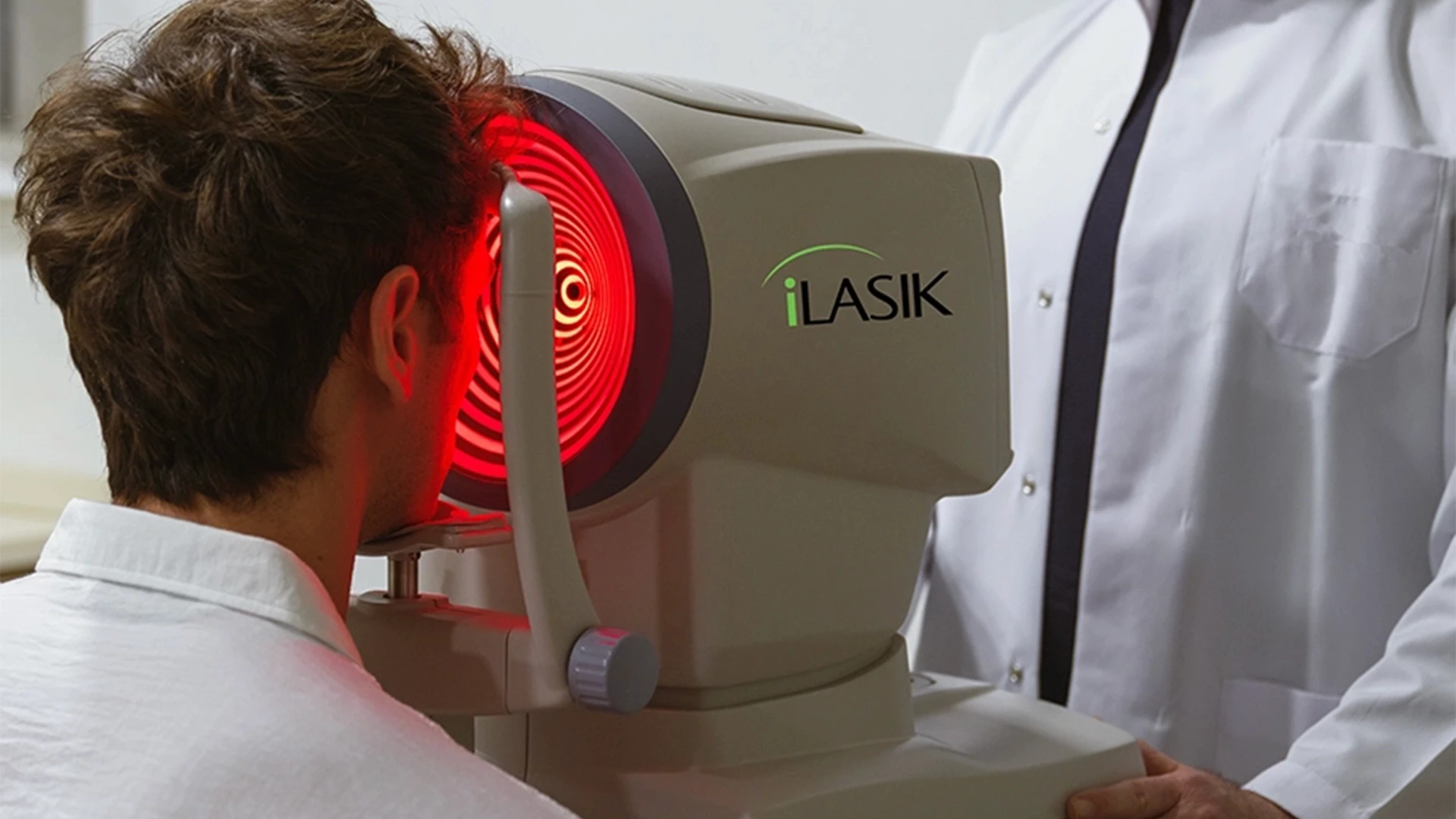
Lens implantation
The lens implantation takes place on an outpatient basis in the surgical area of the clinic. The procedure itself is short and is carried out routinely under controlled medical conditions. Depending on the individual course of events and medical advice, you will either stay overnight in the clinic or in a hotel. Support is available to you at any time even after the procedure.

Follow-up examination
On the following day, a detailed follow-up examination will take place. During this, the healing process will be checked and the treatment results monitored. You will receive your medical report as well as all important information for the time after your return trip. This appointment will also be conducted in German.
On the last day, a follow-up examination can also take place if necessary. After the follow-up examination, you will begin your journey home. The transfer will bring you to the airport on time. Please schedule your return flight for the afternoon.

| Your way to clear sight
Your Lens Implantation Treatment Process Explained Simply
Arrival in Istanbul
Upon your arrival, you will be welcomed by the transfer service and taken to your hotel. The rest of the day is at your leisure. You can relax or collect your first impressions of Istanbul. No medical treatment will take place on this day.
Detailed preliminary examination
On the second day, a comprehensive ophthalmological preliminary examination will take place at the partner clinic. All relevant measurements will be taken, including those for eye structure, lens position, and visual acuity. Based on these results, a decision will be made regarding which lens is medically appropriate and how the procedure will be planned in detail. A German-speaking assistant will accompany you throughout the entire appointment and explain each step calmly.
Lens implantation
The lens implantation takes place on an outpatient basis in the surgical area of the clinic. The procedure itself is short and is carried out routinely under controlled medical conditions. Depending on the individual course of events and medical advice, you will either stay overnight in the clinic or in a hotel. Support is available to you at any time even after the procedure.
Follow-up examination
On the following day, a detailed follow-up examination will take place. During this, the healing process will be checked and the treatment results monitored. You will receive your medical report as well as all important information for the time after your return trip. This appointment will also be conducted in German.
On the last day, a follow-up examination can also take place if necessary. After the follow-up examination, you will begin your journey home. The transfer will bring you to the airport on time. Please schedule your return flight for the afternoon.
| Your way to clear sight
Your Lens Implantation Treatment Process Explained Simply
Arrival in Istanbul
Upon your arrival, you will be welcomed by the transfer service and taken to your hotel. The rest of the day is at your leisure. You can relax or collect your first impressions of Istanbul. No medical treatment will take place on this day.
Detailed preliminary examination
On the second day, a comprehensive ophthalmological preliminary examination will take place at the partner clinic. All relevant measurements will be taken, including those for eye structure, lens position, and visual acuity. Based on these results, a decision will be made regarding which lens is medically appropriate and how the procedure will be planned in detail. A German-speaking assistant will accompany you throughout the entire appointment and explain each step calmly.
Lens implantation
The lens implantation takes place on an outpatient basis in the surgical area of the clinic. The procedure itself is short and is carried out routinely under controlled medical conditions. Depending on the individual course of events and medical advice, you will either stay overnight in the clinic or in a hotel. Support is available to you at any time even after the procedure.
Follow-up examination
On the following day, a detailed follow-up examination will take place. During this, the healing process will be checked and the treatment results monitored. You will receive your medical report as well as all important information for the time after your return trip. This appointment will also be conducted in German.
On the last day, a follow-up examination can also take place if necessary. After the follow-up examination, you will begin your journey home. The transfer will bring you to the airport on time. Please schedule your return flight for the afternoon.
| Contact us Today
Plan your online meeting with us
Book a consultation appointment and get closer to your journey towards a breathtaking transformation.

| Contact us Today
Plan your online meeting with us
Book a consultation appointment and get closer to your journey towards a breathtaking transformation.
| Contact us Today
Plan your online meeting with us
Book a consultation appointment and get closer to your journey towards a breathtaking transformation.
| FAQ
Frequently Asked Questions
Do you have any questions?
Can't find the right answer? Just write us a message on WhatsApp and we will get back to you as soon as possible!
Ask via WhatsApp
How does a single vision lens work?
Monofocal lenses are a variant of intraocular lenses (IOL) that are used instead of the body's own lenses. They are intended to correct cataracts, refractive errors, and possibly presbyopia (age-related farsightedness). In terms of functionality, they are similar to conventional eyeglass lenses with corrective power.
What are the requirements for monofocal lenses?
Apart from cataracts, the eyes must not be affected by a serious illness. The patient should be in good health. Pregnancy or breastfeeding excludes any procedure. Patients can have monofocal lenses implanted as soon as they reach the age of 18. However, such implantation is usually only performed at an advanced age (40+ years).
How is the implantation of a monofocal lens carried out?
The implantation of the monofocal lens is carried out on an outpatient basis under local anesthesia and takes about 15 minutes per eye. The interval between the operation of the first and second eye is usually one to two days. The eye's natural lens is removed. Then, the natural lens is cut and suctioned out. The monofocal lens is then inserted through the incision and placed where the natural lens was previously located.
How do the costs for monofocal lenses behave?
Monofocal lenses are significantly more expensive than laser eye surgery in many cases, as the costs of the artificial lenses are added to the surgical costs. In contrast to multifocal lenses, however, the costs for single-focus lenses are considerably lower.
| FAQ
Frequently Asked Questions
How does a single vision lens work?
Monofocal lenses are a variant of intraocular lenses (IOL) that are used instead of the body's own lenses. They are intended to correct cataracts, refractive errors, and possibly presbyopia (age-related farsightedness). In terms of functionality, they are similar to conventional eyeglass lenses with corrective power.
What are the requirements for monofocal lenses?
Apart from cataracts, the eyes must not be affected by a serious illness. The patient should be in good health. Pregnancy or breastfeeding excludes any procedure. Patients can have monofocal lenses implanted as soon as they reach the age of 18. However, such implantation is usually only performed at an advanced age (40+ years).
How is the implantation of a monofocal lens carried out?
The implantation of the monofocal lens is carried out on an outpatient basis under local anesthesia and takes about 15 minutes per eye. The interval between the operation of the first and second eye is usually one to two days. The eye's natural lens is removed. Then, the natural lens is cut and suctioned out. The monofocal lens is then inserted through the incision and placed where the natural lens was previously located.
How do the costs for monofocal lenses behave?
Monofocal lenses are significantly more expensive than laser eye surgery in many cases, as the costs of the artificial lenses are added to the surgical costs. In contrast to multifocal lenses, however, the costs for single-focus lenses are considerably lower.
Do you have any questions?
Can't find the right answer? Just write us a message on WhatsApp and we will get back to you as soon as possible!
Ask via WhatsApp
| FAQ
Frequently Asked Questions
How does a single vision lens work?
Monofocal lenses are a variant of intraocular lenses (IOL) that are used instead of the body's own lenses. They are intended to correct cataracts, refractive errors, and possibly presbyopia (age-related farsightedness). In terms of functionality, they are similar to conventional eyeglass lenses with corrective power.
What are the requirements for monofocal lenses?
Apart from cataracts, the eyes must not be affected by a serious illness. The patient should be in good health. Pregnancy or breastfeeding excludes any procedure. Patients can have monofocal lenses implanted as soon as they reach the age of 18. However, such implantation is usually only performed at an advanced age (40+ years).
How is the implantation of a monofocal lens carried out?
The implantation of the monofocal lens is carried out on an outpatient basis under local anesthesia and takes about 15 minutes per eye. The interval between the operation of the first and second eye is usually one to two days. The eye's natural lens is removed. Then, the natural lens is cut and suctioned out. The monofocal lens is then inserted through the incision and placed where the natural lens was previously located.
How do the costs for monofocal lenses behave?
Monofocal lenses are significantly more expensive than laser eye surgery in many cases, as the costs of the artificial lenses are added to the surgical costs. In contrast to multifocal lenses, however, the costs for single-focus lenses are considerably lower.
Do you have any questions?
Can't find the right answer? Just write us a message on WhatsApp and we will get back to you as soon as possible!
Ask via WhatsApp
Request now

Your Beauty and Health Agency
since 2006
The treatments are carried out in contractually bound health facilities approved for international health tourism.
Opening hours
Office - London 128 City Road, EC1V 2NX
Monday to Friday: 9:00 AM – 6:00 PM Saturday: 10:00 AM – 2:00 PM

Consulting center since 2008.
TÜV certified since 2012

Certificate for International Health Tourism

Your Beauty and Medical Agency since 2006
The treatments are carried out in contractually bound health facilities approved for international health tourism.
Opening hours
Office - London 128 City Road, EC1V 2NX
Monday to Friday: 9:00 AM – 6:00 PM Saturday: 10:00 AM – 2:00 PM
Consulting center since 2008.
TÜV certified since 2012
Certificate for International Health Tourism
Copyright © Beauty Travels 24 2006-2026
Your Beauty and Medical Agency since 2006
The treatments are carried out in contractually bound health facilities approved for international health tourism.
Opening hours
Office - London 128 City Road, EC1V 2NX
Monday to Friday: 9:00 AM – 6:00 PM Saturday: 10:00 AM – 2:00 PM
Consulting center since 2008.
TÜV certified since 2012
Certificate for International Health Tourism